Social media is bombarding us with ‘therapy speak’. There is a label for everything, we can’t move for triggers, and there is a fixation with over analyzing trauma. I remember when I was in a terrible place with my mental health, I used to seek this stuff out, thinking it was going to help me get out of the awful place I was in. Little did I know that it was doing the very opposite.
Training to be a Solution Focused Hypnotherapist opened my eyes. It gave me the neuroscientific reasons why talking about your problems repeatedly, is not the way to solve them.
My first feelings were of grief and sadness. Why had no one told me this before? I felt like I’d wasted so much energy, and time being unhappy. This is something I hear from many of my clients. People who have spent a lot of time and money diving deep into their problems, and moving no closer to solving them.
But I didn’t realise there was another way to do things. A simpler, kinder, science based way, that didn’t involve re-traumatizing myself. When I explain this to clients in the initial consultation, some burst into tears of joy at the relief of not having to retell their trauma story all over again.
So why should we stop talking about our problems, in order to solve them? Because I know what you’re thinking – surely that’s backward logic. So, let me give you 3 reasons why it makes perfect sense.
The brain doesn’t know the difference between imagination and reality.
Think about if we’re watching something scary on T.V – our heart rate increases, our breathing might get short, we feel scared. Our brain thinks what’s on screen is happening to us, and is providing us with all the necessary chemicals to deal with a dangerous situation. It works exactly the same when we think about and talk about our problems. The body takes us into the Primitive brain (fight/flight brain) and prepares us to face the situation all over again. So imagine if you’re regularly thinking and talking about a distressing situation, the body will keep gearing back up to protect you, all over again.
Going over and over our problems, we are continually adding to our stress bucket.
- It is our thoughts that stress us – negative thoughts are converted into anxiety, and this goes into our bucket. So if we keep talking about stressful topics, our thoughts are negative and distressing, and this fills up the stress bucket.
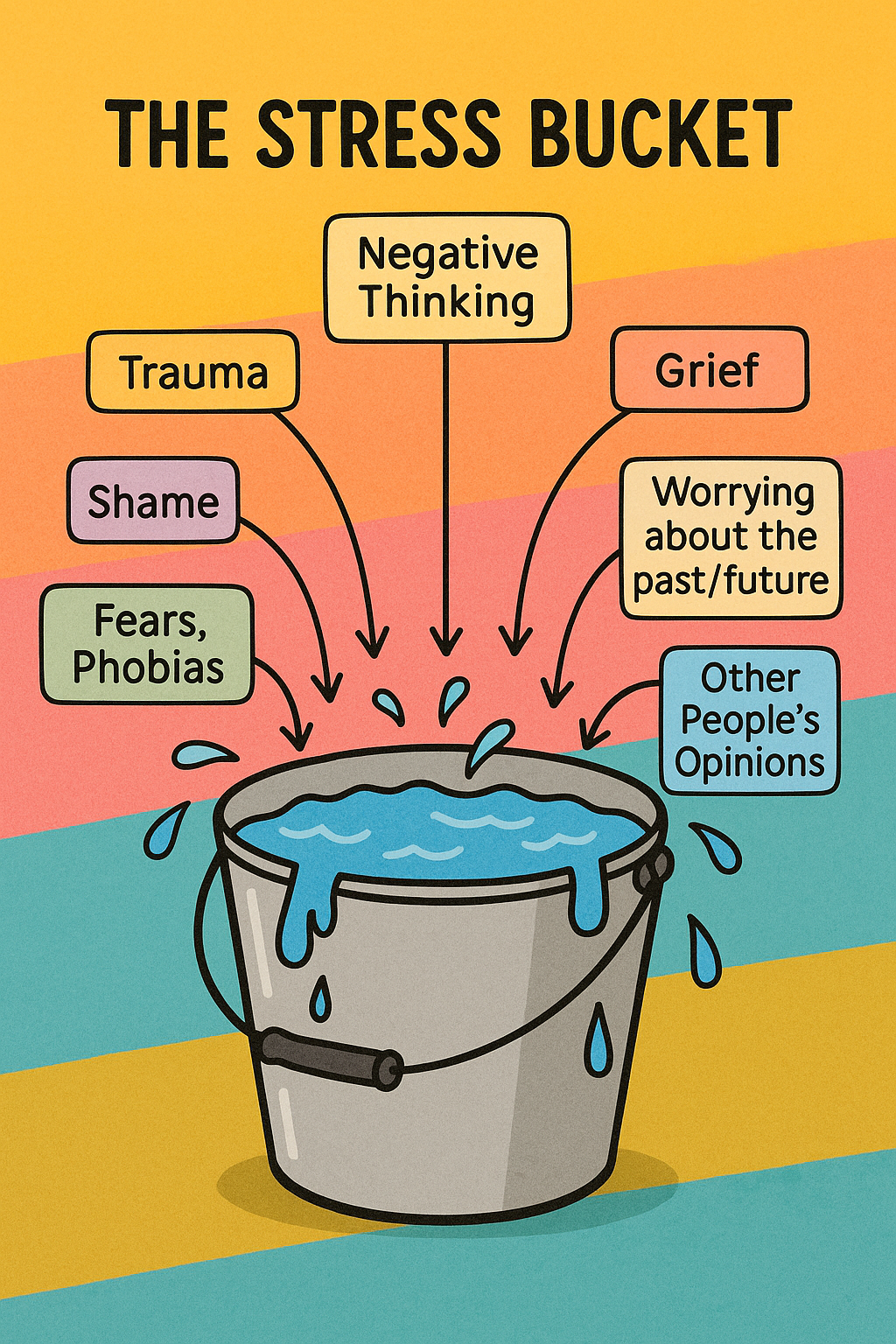
The contents of our Stress bucket get emptied during REM sleep, not by talking about them.
REM is the dreaming part of our sleep cycle. but it is only 20 percent of each 90 minute cycle – not a great amount. So if our bucket is constantly being added to, REM will never be able to empty enough out of it to give us back a good amount of capacity.
Think of this as each time we talk about the problem, we load that memory back into the stress bucket to be dealt with all over again. This is an exhausting process, as the brain is working harder during REM sleep, than it is when you’re awake. So if your bucket is constantly being added to, your brain will be tired, and trying to catch a break. This manifests as exhaustion. Clients regularly tell me during their initial consultation, that as soon as they sit down to watch TV they fall asleep, and that they also struggle to focus on tasks as they keep zoning out. This is because their exhausted brain is using any available opportunity to grab some rest ,or ideally some REM sleep.
Everytime we revisit a situation, by thinking and talking about it, we strengthen that neural pathway in our brain.
Well used neural pathways are like motorways – our thoughts travel quickly and easily down them. Each time we use a negative neural pathway, the brain responds by providing us with stress hormones, cortisol and adrenaline. These make us feel anxious, angry, or depressed, and produce unpleasant physical symptoms like IBS, migraines, and sleep issues. We get so used to using these pathways, that our body gets really good at responding – its trying to keep us safe from the danger it thinks we are experiencing, by activating our fight and flight response.
When this concept was first introduced to me, it was a huge lightbulb moment.
I had finally found an effective, alternative to traditional talk therapy.
I learnt that the more we notice, think about, and talk about positive things, the more serotonin we produce, and therefore the more time we spend in our Intellectual brain. This part of the brain is helpful, rational, positive, and creative. Its where we make good decisions, and can plan forward. This means our behaviour is more productive, and communication is clearer. Because of this, we add less to our bucket, do less of the unhelpful stuff, and are able to get deeper, better quality sleep. Win, win! More REM, but less for it to do!

So how about we flip this around…
Now we know our stress bucket is emptied by REM sleep, rather than talking about our problems, how about we spend our time talking about whats been good?
The ‘What’s been good?’ can be a challenge at first. We don’t go round asking people this, so initially our brains are not practiced in noticing, and keeping track of positive data. Our brains have a natural, negative bias – to keep us alive. However, in order to feel happier, and solve those painful problems, we need to practice using our brain differently. We need to work on making it feel safe, so that it moves away from being negative, and into being solution focused.
Just like the strong neural pathways we can build with negative thoughts, we can also build strong neural pathways with positive thoughts. The more we practice using our brain to think about whats been good, the more we create and strengthen new neural pathways that give us productive results. Just like training muscles in our arms or legs, we need to train our brain. We need to keep practicing and repeating, in order to get stronger. Then, thinking and noticing what’s been good becomes easier.
Download my FREE Brain-Shift Shift Guide

What we always need to remember is that our brains can change and remodel daily. They have an incredible ability called Neuroplasticity.
This means, just like plasticine, they can reshape daily, pruning out whats no longer being used, and getting rid of it overnight. Over time, if we use those negative pathways less and less, the brain will recognise them as redundant, and prune them out. Think of it like pathways through an overgrown meadow. Once you stop walking on a path, the grass will start to grow back, other plants will cover the track, and it becomes harder to use.
This change can feel overwhelming at first, we have been so used to thinking, talking, and behaving in a certain way. Our brains have grown to feel safe, under a negative umbrella. Change can feel dangerous for the brain initially, as we are stepping out of our comfort zone. This is why it is important to start small and build.
Small steps are essential for the brain. Small wins give us the reward of dopamine, making us want to take further action. They also prevent us from giving up due to ‘delayed discounting’ – if the goal is too big, the brain gives up on it, and does for something much easier like eating chocolate, or watching T.V.
Small steps also enable your brain to safely collect data. Our brain needs data to show it that an activity is safe to repeat. This is how we can edge our way out of anxiety and fear, and grow our comfort zone.

If youre looking for that alternative to traditional talk therapy, but have no idea where to start, Solution Focused Hypnotherapy is a fantasic option.
It is 100 percent rooted in modern Neuroscience, and blends Solution Focused talk therapy and deep relaxation. These two work hand in hand to support you to change your thoughts and your behaviour. Solution Focused Hypnotherapists educate their clients to become empowered, within themselves, rather than reliant on the therapist.
It provides a simple science based structure, and tools ,to enable you to plan and take manageable action to create lasting change. No therapy speak, no ‘you just need to relax and think more positively’ , just straightforward sessions that help you cope better.
Solution Focused Hypnotherapy allows you to Zoom out, rather than deep dive into your problems. This lets you gain perspective, meaning you can step back, calculate your next move carefully, and confidently progress forward.
